Saturday, January 19, 2013

A (Very) Early Spring Day in Chicago

On Jan 9 I stepped out and sniffed the 50-degree+ Chicago air. Like an animal waking from its winter slumber, I smelled the warm earth and immediately had the urge to plant something. So I located a few empty SIPs and washed them in hot vinegar water.

Happily, I have a friend on the roof to hoist up my planting boxes and watering can (no running water up there in winter, despite these occasional oddly warm temps).

The sun was shining as I opened the potting mix bin to reveal a couple of bags of peat, ready to be mixed with perlite this spring to create fresh potting mix.

I filled my small SIPs...and added a little balanced fertilizer.

Our growing roof is all tucked in for winter. Some of those yellow SIPs have even been washed and dried, stored now in the unheated greenhouse, which is where I'm heading.

I always have winter-spring seeds on hand, including some I ordered from Franchi late this fall.

Root Simple recently wrote about one of Franchi's gorgeous salad mixes, shown here growing in their LA garden. Eye-popping color.

Hey, I'm planting! This makes me happy.

We watered in the seeds lightly and covered the grouping with a plastic bag. As the greenhouse warms on sunny days, so too will the potting mix. During the single-digit cold coming this week, the mix will freeze, mimicking the in-ground environment.

When spring temperatures and increasing sun crack those seeds, they'll show some green, like these snap peas I planted in SIPs in the greenhouse in just the same way last winter. Here are their sturdy sprouts on March 11, 2012, when they were easily lifted and transplanted to one of our earthboxes. Check out the root development.
Why not plant peas or greens directly into a SIP? The greenhouse-trapped sun and heat prompts  germination weeks earlier than otherwise on our roof. A head start on good eating.

Thursday, January 10, 2013

Uli Westphal's Ripening Tomatoes

Tomorrow's Chicago temperature is predicted to hit 60. Here's a diversion from what that probably means, Berlin artist Uli Wesphal's view of tomatoes ripening.


If you've never checked out his Mutato Archive...go look.

Thursday, November 29, 2012

"My" Bees Are Gone

They disappeared from the rooftop hive about a month ago.  Given the state of the hive and environs, we don't think they absconded. That leaves Colony Collapse Disorder.

The maddening thing about all this is that I'll never really know.  This state of confusion is actively manipulated by the makers of neonicitinoids, like Bayer.

The regulatory process in Europe, much as it is in the U.S. is useless.

Evidence submitted to parliament cites a long list of failings in current regulations. Perhaps most serious is that it is only the effects on honeybees that are considered, despite 90% of pollination being performed by different species, such as solitary or bumblebees, hoverflies, butterflies, moths and others. Another is that the regime was set up for pesticide sprays, not systemic chemicals like neonicitinoids that are used to treat seeds.

Even the National Farmers Union (NFU), which argues that there is no need for change, admitted: "It is very well known that the current pesticide risk assessment systems for bees were not developed to assess systemic pesticides."

Nigel Raine, at Royal Holloway, University of London, highlighted other failings in a recent study. First, insecticides are tested singly, despite the European regulator reporting that "pesticides are often applied in tank mixes (two to nine active ingredients at the same time)".

Tests also wrongly focus on individual insects, according to Connolly: "For social insects, it is the colony that is the breeding unit and the most important."

Goulson said as little as 2% of the neonicitinoids applied to the seeds actually ends up in the plants. "There is an urgent need to establish the fate of the other 98% and to find out what impacts they might be having on the environment," he said.

I ended up with a quart of honey from the lifeless hive.  My beekeeping friends (Hi Michelle and Karen!) and I will try again next year. We plan on adding an extra hive or two while we're at it.

Monday, November 12, 2012

A True Garlic Story:


I was planting garlic cloves and it started to rain hard. I decided to call it quits and put the few extra large cloves in my pocket but I forgot to check my pockets before washing my clothes. I realized what I had done after I opened the dryer and was overcome with a strong garlic fragrance that filled the room. I couldn't stop laughing when I saw one of the garlic cloves tumble out of the dryer! Ahh… another memorable gardening moment! 

Tuesday, October 23, 2012

Oct 2012: 80-Degrees Roof Clean-Up (?) + Flowering Tomatoes

It poured yesterday, but 80 degrees is predicted for Wednesday (with temps in the 70s bookending it), making this a good Chicago week for roof clean-up, which entails cutting back plants and getting damp potting mix out of the SIPs to dry.

I'm letting those tomatoes up there ripen on the vine, hoping a kiss of warmth this week will sweeten them further.

Amongst the detritus Oct 22:

Cleaning the growing roof involves lowering down tubs filled with spent plant material to the compost bin on the ground. It's the very antithesis of in-ground organic growing, where end-of-season plants can simply be knocked down and left alone or dug under.

On the roof, we cut off and pick up every last bit to keep the gutters clear and prevent a layer of compost from developing on the roof's reflective surface. That old adage is true: compose happens.

Saturday, October 20, 2012

Still More Tomatoes Oct 2012

Picked another 6 pounds this week, each one a gift. Heading to the roof now to see what else might be dangling from the withered vines.

Friday, October 12, 2012

At Last, Tomatoes 2012

We snarked and moaned, inundated you with Chicago's early heat stats straight from Tom Skilling's weather center, and just about entirely missed the first round of tomatoes due to the unbelievale heat this summer.
But by virtue of a little good luck, accidental planning, and tenacity--yes, we didn't give up watering the scorched-earth-looking tomato plants--we've had a beautiful tomato harvest over the past eight weeks. I've just been too busy to post about it.

The uber-reliable for our climate

How to describe the joy of finally having enough of this queen fruit to worry about what to do with 'em all? Eight words do it justice: Marcella Hazan's Tomato Sauce with Onion and Butter. For my time and effort, this is the easiest and most flavorful sauce to make with a load of tomats. After cutting into chunks this size and letting them cook down, we freeze it.

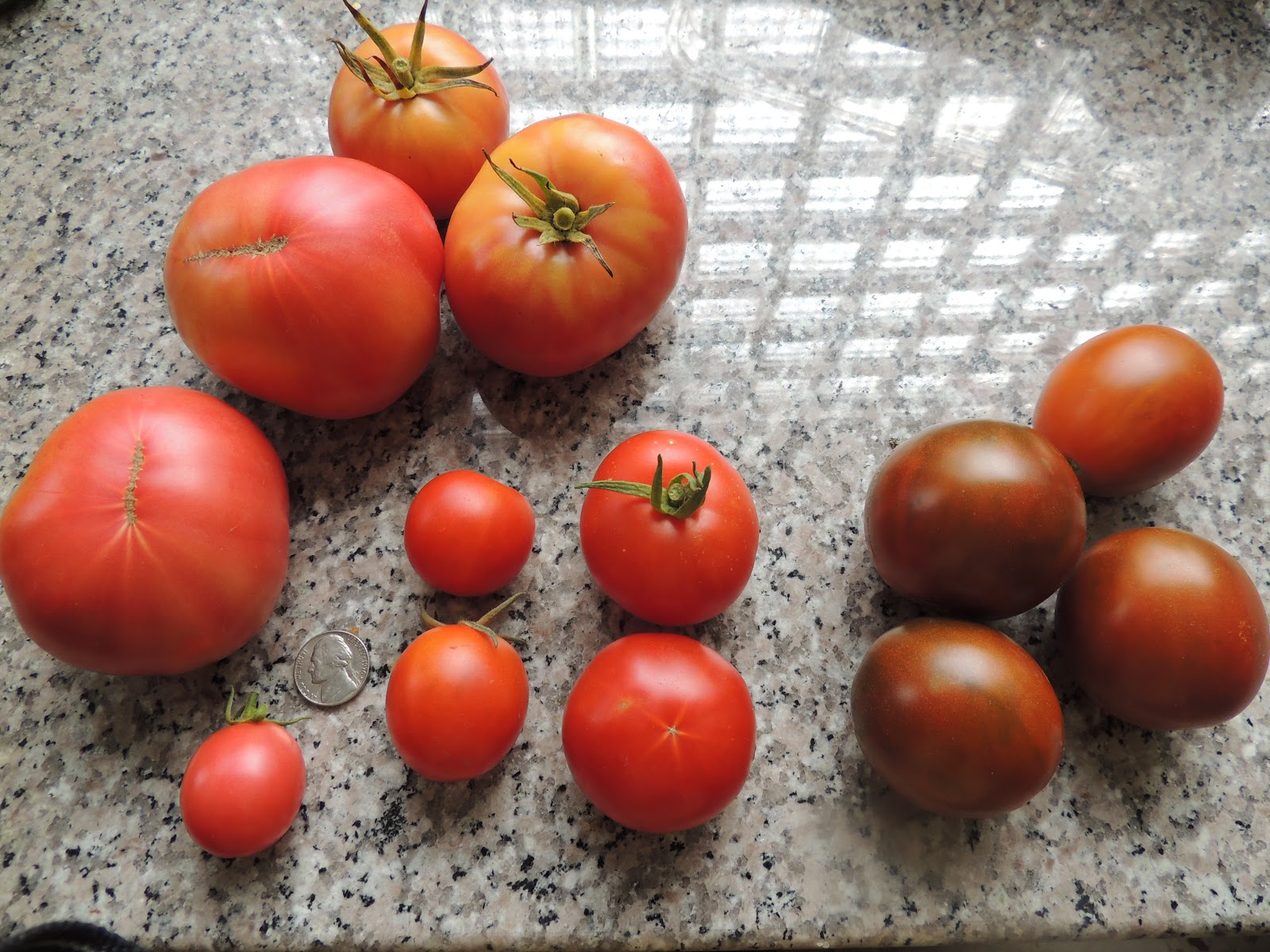
Mostly we've been returning from the roof with small to mid-sized 'maters. Happily, we planted Glacier, Stupice, Black Prince, Brazilian Beauty, and Crnkovic, the last not small by any stretch but early and clearly good for the long haul (the plant looked devastated two weeks ago but was loaded with large maturing fruit). What Bountiful Gardens says about Brazilian Beauty:
Forty years ago, Gordon Brown was at a nursery when a hippie van full of tomato plants pulled up. All the tomatoes were rare types from Brazil, and they were for sale. The nursery owner didn’t want them, so Gordon bought some, and this variety was the standout. He’s kept it going to this day, a rare and unbelievably tasty tomato. Unusual, mahogany color with green shoulders. Very good yields. Closest non-hybrid we’ve seen to that sweet, tropical “sungold” flavor.
Brazilian Beauty at lower right. 
Continuing clockwise: Glacier, Stupice, 
the tiny Whippersnapper, Crnkovic, and not sure

Some turn up their noses at small varieties. Not in this house. Yes we had a few BLT monsters that outsized the bread they sat on, like this one (hard to believe, given our growing season).
But the small intensely flavored heirlooms are right for so many reasons: they got started and thrived even in the early heat, delivering fruit when no larger tomato could.

And they kept on delivering.