When you see the first summer harvest on your cutting board, you know another season of good eating is underway.
 The heirloom Black Sea Man start came from a local nursery in the wake of our early tomato troubles.
These eggplant taste like cream to me and cook in moments. I halve them lengthwise and lay face-down in a hot cast-iron skillet with a little hot peanut oil over medium-high heat. Let them sear a few minutes and then flip and briefly cover and cook until soft. The pingtung long don't even need a cover.
A drizzle of olive oil, S&P, and there you have it: lunch. I also sliced and fried a couple of the peppers just below. They're hotter this year at this early stage than they were last year.
and summer greens
 (I moved the cool-weather greens to a shady part of the roof to extend their production.)
I do love those Santa fe grande peppers--sturdy growth and endless fruits, pretty colors (yellow to flaming red) and variable Scoville heat.
Money shot of the Sea Man:grey winter dreams come true

You don't need a roof full of soil to do this or a fancy vertical garden system. And you don't need to spend a lot of money either. I stand with our pals at Homegrown Evolution on this (and not just because they linked to us, but hey thanks!): vertical farming is alluring in all sorts of ways...but impractical for many and currently not the most economical way to grow.
As Erik at Homegrown says:
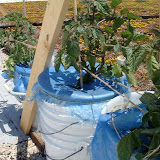
A SIP is as close to "plant and forget about it" as you can get with vegetables. In short, perfect for schools where maintenance is always an issue.Thanks in part to Bob Hyland's Center for Urban Greenscaping (CuGreen) students in Brooklyn took home their school SIPs for summer vacation.
The SIP home base is the PS 102 garden but due to limited access over the summer recess, it is not the best place to be. That is why the SIPs are growing fresh vegetables at the homes of parents and teachers over the summer.Here's the truth: you can grow all kinds of food without any trellising at all: bush beans, determinate tomatoes, eggplants, and most peppers. Still, I find trellis vegetables some of the most beautiful because of their twining habit and the way they hang off a vertical plane. So maybe that's part of the allure.
Art made this vertical extension on our cool-weather greens run (which I promised him would never be used for climbing things and therefore wouldn't require a climbing frame...thanks, love). He re-used some wood, bought a couple of 2X3s, and found the small grids at Salvation Army. They appear to be from the endless stream of Ikea junk that ends up on the sidewalk, in the garbage, or at resale shops.
No problemo, we take what we can find. The green grids are from an auction years ago. You could also used old refrigerator shelving as climbing structure. Soon the thin-skinned and deliciously cooling Armenian cukes will be scrambling upward.
 Regardless of whether your vegetables are climbing or just squatting in their SIPs, early summer delivers magic.
 Almost any garden,
if you see it at just the right moment,
can be confused with paradise.
--Henry Mitchell