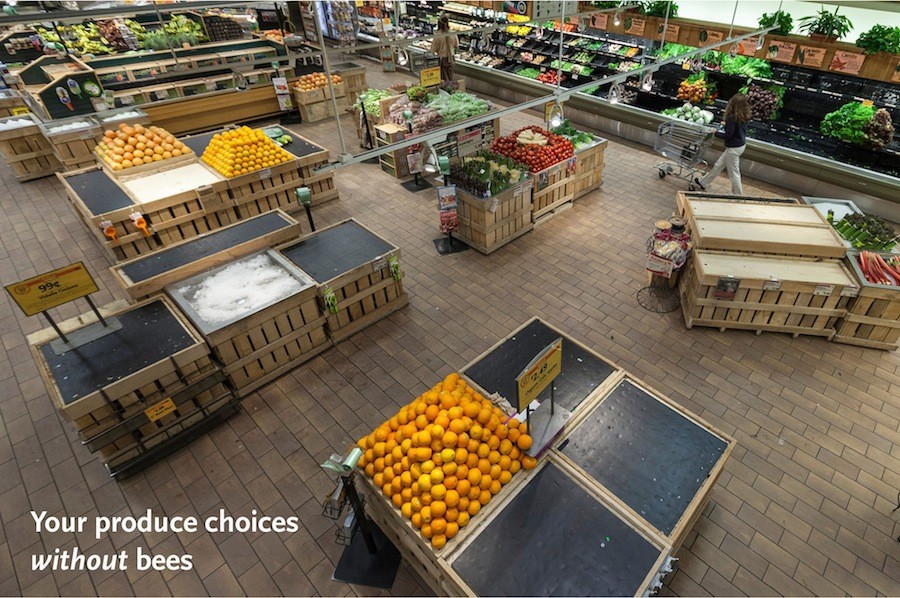
Our bees didn't make it through winter and we didn't bring in fresh ones. I feel guilty about that and I miss their companionship when I'm working on the roof, but we have our reasons.
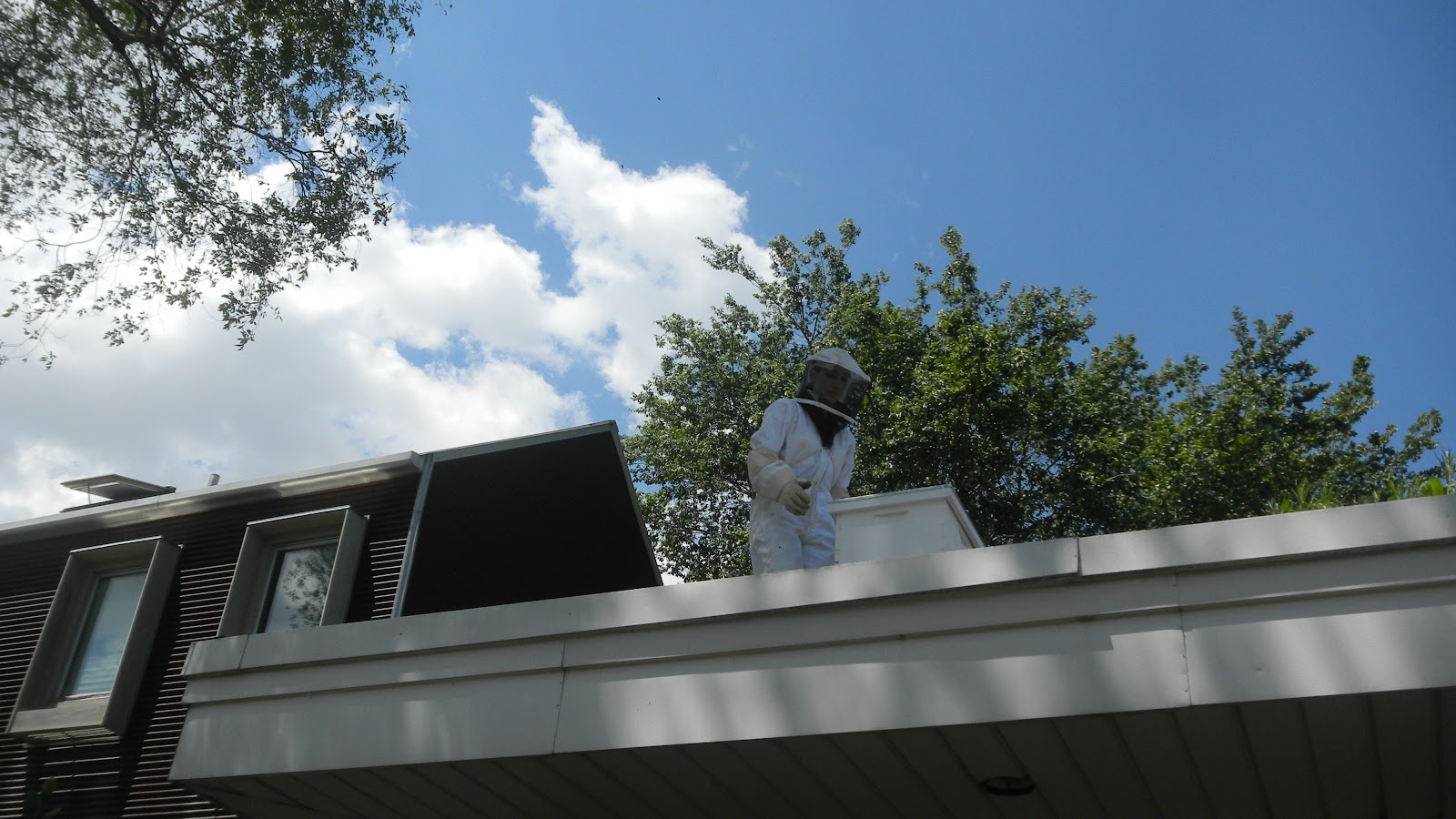
Noam our emminently capable beekeeper couldn't manage it this summer and neither could best back-up Robin. Looking at pix like these is sobering.
Bruce has a beehive, nice complement to his expanding agrarian plot in Chicago. Tended by volunteers from the Garfield Park Conservatory (click on the link to see the horrendous damage from last year's hailstorm), the hive sits on the roof of his garage.
When I stopped by last week to pick up the beautiful tomato/eggplant/pepper starts that Bruce has been tending, the crew was cracking the hive for a closer look. All is well.
Trimming a large tree means this eastern garden bed gets a lot of nice light. It's filled with herbs including white borage that popped up from last year, and will soon host a couple tomato plants.
Speaking of bees, over on our roof Noam was surprised to find we were missing two queens. Undaunted, we ordered more from Simpsons in Ohio. They were shipped with clear instructions for the post office to hold for Noam's pick-up, but instead our delivery person dumped them through the mail slot. The queens are currently caged but in position, their pheromones wafting through the two hives. We'll be underway again soon.
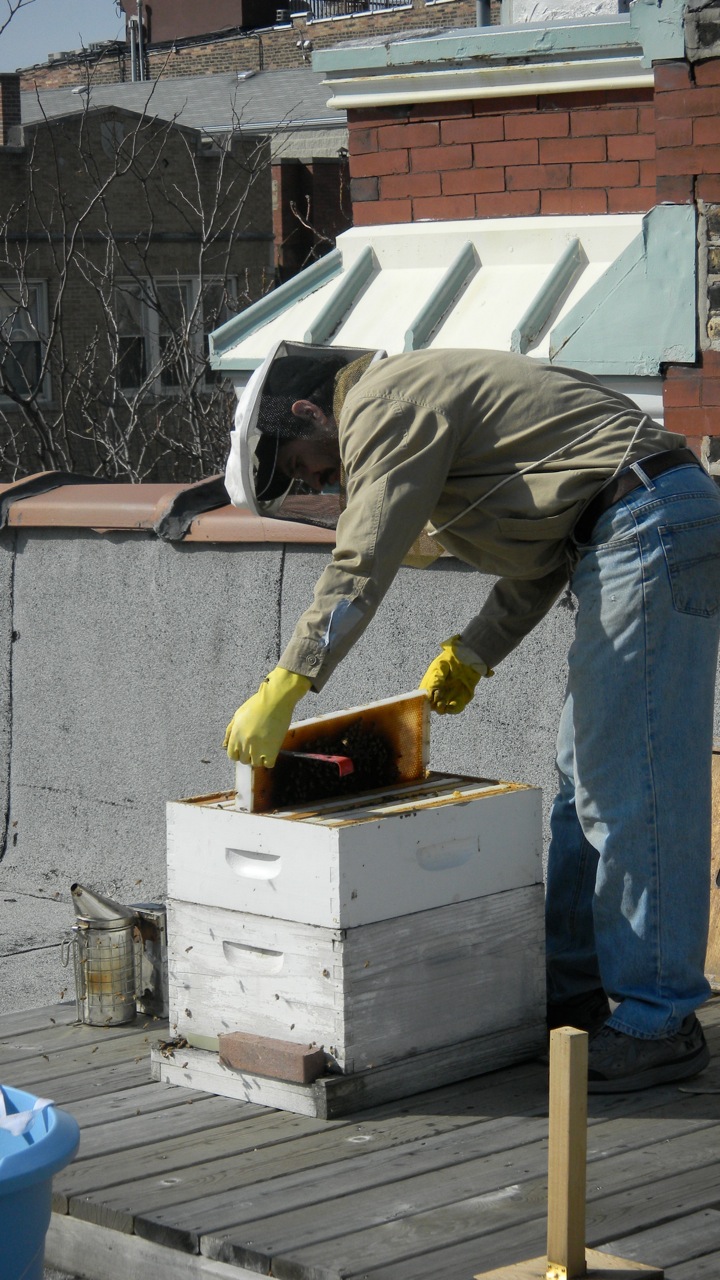
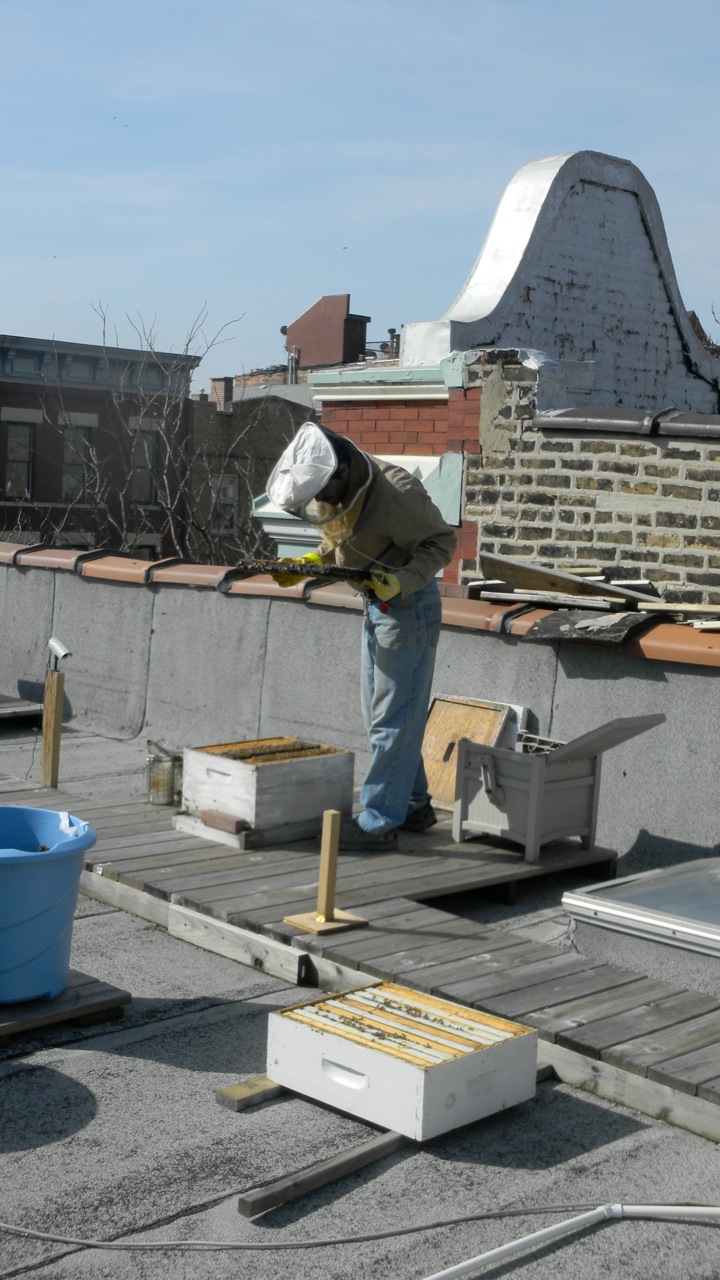
Noam came over to Art and H2's to check on their two hives. The exceptionally warm weather we've had this year has led the bees to start their pollen (used to build bee muscles and glands) and nectar (the carbohydrate source that keeps the bees running) gathering early, and he wanted to make sure everything was ok.
He explained that, among other things, he would be looking to see that the queen(s) were laying brood--baby bees--and checking for any signs that either hive was getting full, which would cause the bees to swarm.
(Click on any picture for a larger view.)
After putting on his veil, Noam lit the smoker.
He first addressed what he guessed would be the "weaker" of the two hives; the one he thought, given its past performance, might not have made it through the winter.
After removing the top and inner cover, he scraped away the propolis holding a frame to the hive body and pulled it out.
Not finding any in the upper body, he set it aside and checked for brood in the lower super.
Success! The queen is laying. The capped brood cells are a dull orange in color and are mostly hidden by the mass of bees in the top center of the frame.
Turning his attention to the second hive, upon taking off the cover he immediately noticed that bees were spilling out the tops of all the frames. No doubt the queen was laying here. Not only that, they were running out of space. Unless he added another hive body, they would fly off en mass, or swarm, in search of a larger home.
He pulled an unused medium hive body from his stores and placed 9 empty frames inside.
In order to prevent the queen, with its larger thorax, from migrating to the upper hive bodies, he places a "queen excluder", basically a screen, above the lower two hive bodies. Those lower bodies are exclusively for brood. Anything higher in the hive will contain only honey, so there is no danger of "harvesting" the queen when its time to extract honey.
Here he is scraping last seasons propolis from the exluder.
Excluder in place, he lowers the new, empty framed, hive body in place.
What a sight! The bees were absolutely crazy this morning, Feb 29 2012. It's nearly 60 degrees F in Chicago before 9 am...spooky if you ask me. But we're delighted both hives look so robust.
ps: for new readers, the images in this vid come from the downstairs monitors, wired into our two hives on the roof. We hope to have a live beecam this spring.
In Chicago it's 40 degree F on January 27, but bees and humans alike share a little joy in the strengthening full sun. That's all it takes.
I went to the roof, where it was 75 in the unheated greenhouse (it needs organizing, but today's not the day). I'd seen some real bee activity on my bee monitor downstairs and thought I'd grab a quick vid. But as I drew closer the bees signaled their dislike by sending out a couple of peevish scouts to push me back.
No harm done--they apparently just don't recognize me in the dead of winter as they do in summer. Wondering about that wooden post in the video? Just 7 days ago it was measuring snowfall (we ultimately got near 7 inches).
Downstairs, full sun on the hoop enclosure too--far too warm in there for cool-loving greens, so I opened it up.
Attaching a piece of conduit to the edge of the Agribon fabric (shown in this post) really does make it easy to lift the fabric as a single entity and rest it on top of the hoops. These plants were happy to just breathe.
What a joy seeing this deep green parsley popping out with all the other usual suspects--tatsoi, mustard, arugula, kale. I'm kind of winging this whole low tunnel effort. Fast Grow the Weeds gives me a clue:
I planted ... kale and salad greens back in late September. These will be completely harvested by late March and then I’ll convert this greenhouse into a seedling nursery.
Guess I'll follow suit.
But instead of thinking about it, I picked a salad.
H2 and Art have had two hives, tended by beekeeper Noam, on their roof for the past couple of years. Since they started, I've been thinking about tending my own hives on my roof.
I'd like to have feral bees, ones that have by their very existence, shown that they have the genetics to survive without treatments, pesticides, or other human intervention. The philosophy is outlined in books like The Complete Idiot's Guide to Beekeeping, sites like Michael Bush's, and by the Backwards Beekeepers.
Here's a nice video of Backwards Beekeepers Kirkobeeo demonstrating how to capture a feral swarm.
I'd like to find a local beekeeping group that does this kind of work.
I'm not sure how interested I am in doing this -- bees don't have any special hold on my imagination, and I'm a little unsettled by the prospect of a steady dose of bee stings. Then again, I felt the same way about chickens this time last year, and look how well that experiment turned out.
According to this piece, the nectar of spring-flowering trees has a higher sugar content...to attract pollinators like bees. Chicago is in bloom right now, happily for our feisty foragers.
Saw this one walking to Bruce's today.
And this one walking to the produce store.
Bees won't have much luck with this one, though...
When our beekeeper pal Noam called to say he was departing last night for Barcelona (Madrid v Barcelona, compelling reason indeed to travel), he said the timing should still work for him to introduce the new bee colony into Hive 2. Noam came over with apprentice Robyn, who's been taking classes and was eager for an up-close look at the hives.
Backing up, Hive 2 didn't make it through the winter, sad, but nature has her reasons. Most important, there was no apparent disease. The bees seemed to have frozen, though they had honey stores not far away...but perhaps too far to leave the warmth of the colony to retrieve. Yesterday was pick-up day for our new bee family, but delivery was delayed. Noam walked Robyn through the steps just in case she needed to step up. And did she ever.
Step 1: slowly remove the feeder can from the carrier top.
Step 2: locate the queen in her tiny chamber
and with excruciating gentleness lift her out.
The queen goes in first, to be hung from a tab on her little screened box. What's this? Looks like a chicken leg, but it's hundreds of bees who need to move away from their queen so Robyn can hang her on a frame.
Robyn gently runs the encrusted queen chamber against the frame to encourage the girls to release. It worked well. Note the other 9,500 emerging from the carrier box at rear.
Carefully inserting a frame to hold the queen's cage in position.
Slowly (but like she means it) shaking the bees out of their carrier
into their new home.
Lots of craziness at this point, bees swirling. Robyn has shaken most of the colony into the hive. She sets the carrier aside.
And we step back for a minute while the girls get acclimated.
Placing the remaining frames into position...slowly.
Brushing the edges clear.
And topping the hive.
Robyn's a natural. A beautiful first effort and elegantly done. Casa de Italians have settled in well. Here's a vid Robyn shot just after she completed the transfer. For more, come visit us on Facebook.
One thing our Italian honeybees (Apis mellifera legustica) and I have in common: a passion for summer basil. Our bright yellow friends flock to our south-facing front window boxes all summer, but especially when the basil blooms.
This summer I harvested a boatload of basil and tried making these chopped-basil-with-a-touch-of-olive-oil cubes for freezing and using later.
Meh. Something about frozen basil misses the very pungent point. Fresh basil is a luxury I allow myself year round.
Bruce tipped us to this. Haven't seen it yet but looks provocative...
"Filming across the US, in Europe, Australia and Asia, this documentary examines the alarming disappearance of honeybees and the greater meaning it holds about the relationship between mankind and mother earth. As scientists puzzle over the cause, organic beekeepers indicate alternative reasons for this tragic loss. Conflicting options abound and after years of research, a definitive answer has not been found to this harrowing mystery."
Good video. A highlight for me was the hive with a window. Read more here.
...the Tour de Hive offers for those who wish to participate in this free event, the opportunity to see working bee hives in a cluster of Portland neighborhoods, and to ask questions of their hosts to learn more about the bees, and urban beekeeping opportunities.
For so work the honey-bees, creatures that by a rule in nature teach the act of order to a peopled kingdom. William Shakespeare
Did someone say "act of order"? In retrospect, we humans were quite orderly in our descent on the hives to disrupt all the hard work these girls did over the spring and summer. Our weather Sunday -- outside the bee costumes, not in -- was sublime.
So many people were interested in watching/participating. Since it was our first harvest, we didn't know what to expect, but we quickly learned.
It started at 9:30 am, when Noam and Laura, above, suited up (me too!), smoked the hive, and cracked open the casa de Italians in Hive #2.
Noam began by removing each frame and giving it a shake to throw down the bees. Here he's working on Hive #1. And then he'd use his brush to gently encourage the others to leave. He handed off the mostly bee-free frame to me...
...and I handed off to Laura (click to big it up) halfway across the roof. She did a final brush off and placed each frame into a hard plastic bin with lids to keep the bees out. Art devised an attachment for this (heavy when full of frames) box that went onto a pulley. It was then lowered down to the landing on our fire escape. Then the boxes would be carried the rest of the way down.
Remember, the roof is 30 feet up!
Look at the thick comb, filled with honey.
Noam was kind enough to show me how to use the tool, a simple pry bar, to remove a frame. Then I got to try the throw-down maneuver to remove the first bees (I was a little too vigorous, feeling untouchable in that suit) before brushing.
After a lot of backing and forthing, we moved downstairs--as far away from the hives as we could get--where the action picks up. All the honeyed frames have been lowered down, four full boxes worth.
Here Rob carefully removes the wax caps off the hexagonal chambers where bees store their honey. They're incredibly smart. They seal the chambers once they're filled, to protect them.
Note the 1970s-era afro pick (not really, but that's what it reminds me of) used to de-cap.
Rob's an orderly de-capper... ...and Laura's got one all done. Look at the depth of comb...and as a consequence, honey. Once de-capped, two frames fit into the borrowed extractor (thanks to Noam's pal for this). The lid goes on and the crank turns the mechanism, using centrifugal force to pull the honey out and into the bucket. Like this:
Everyone takes a turn turning... ...while we fall into a sort of groove of de-capping and extracting. I'm admitting right here that even though I'm smiling, this is not my favorite task. Rob and Laura were skilled artisans at this. My favorite part was getting globs of wax and honey out of this scraper bowl to eat:
The bees didn't wait long telling each other where all their honey went.
Frequent washing was essential. I'd say this outdoor sink, which Art set up with hot water, was a star of the show. Once the honey starts to accumulate in the extractor it gets strained into the tapper--used to fill jars. Here we tried using my chinoise, whose mesh may have been a little dense for the job at hand, to strain the honey as it flows from the extractor to the tapper. It's an exciting moment--the first pure honey!
Art pulled down his old French cooking strainer, and it fit reasonably well atop the tapper bucket, making the job slightly easier. Here the honey comes out of the extractor...into his strainer...and finally into the tapper.
Noam gets the last of the extracted honey out of his tub.
Now we can start the jarring process. This borrowed tapper unit is meant for making booze and so the tap is a bit poky when filled with the more viscous honey, but that's OK.
We're like a well-oiled machine, with people de-capping, extracting, straining, and filling.
At some point the extent of this harvest becomes apparent. We need more jars, and Bruce comes to the rescue. He wheelbarrows over a bunch of jars he needed for canning this summer. Meanwhile, the scraping bowls from decapping hold a lot of wax. Bruce and Brooke decide they might make candles. Each went home with about 2 pounds of wax to play with. Here Bruce transfers the wax to a go-container. Then Noam and Laura de-capped two frames that are extremely dark in color. He postulates that these Hive 1 frames first housed brood (babies) and then honey. He wants to strain this honey separately, since it's darker. This is a real Martha I-strain-honey-in-my-pretty-sundress-and-necklace moment. The dark honey and the lovely Laura, who had to leave for a quick shower and costume change so she could attend her workplace picnic, where they were roasting a pig--yum. It's all gorgeous. Time for a toast with our neighbors' homemade wheat beer. Thanks Sean and Fran! The perfect ending to a perfect day.
What a fine group effort. So many hands and friends, not all pictured here. And more vids to come.
Thanks, Rob, for the stills and the vids. Thanks to everyone who pitched in. Thanks to Art who never stopped all day and who is strangely absent from the photos.
Most of all, thanks to Noam for his focused tenacity, helping us all learn what to do and toiling from 9:30 until nearly 8 pm to leave us with nicely intact hives and a honey-free work area.
We never did get it all bottled...still working on that indoors here. Gallons to go before we sleep.







 And then he'd use his brush to gently encourage the others to leave.


 Rob's an orderly de-capper...
 ...and Laura's got one all done. Look at the depth of comb...and as a consequence, honey.
 Once de-capped, two frames fit into the borrowed extractor (thanks to Noam's pal for this).
 The lid goes on and the crank turns the mechanism, using centrifugal force to pull the honey out and into the bucket.
 Like this:
 ...while we fall into a sort of groove of de-capping and extracting. I'm admitting right here that even though I'm smiling, this is not my favorite task. Rob and Laura were skilled artisans at this.
 My favorite part was getting globs of wax and honey out of this scraper bowl to eat:

 Once the honey starts to accumulate in the extractor it gets strained into the tapper--used to fill jars. Here we tried using my chinoise, whose mesh may have been a little dense for the job at hand, to strain the honey as it flows from the extractor to the tapper.
 It's an exciting moment--the first pure honey!
 Noam gets the last of the extracted honey out of his tub.


 Meanwhile, the scraping bowls from decapping hold a lot of wax. Bruce and Brooke decide they might make candles. Each went home with about 2 pounds of wax to play with. Here Bruce transfers the wax to a go-container.
 Then Noam and Laura de-capped two frames that are extremely dark in color. He postulates that these Hive 1 frames first housed brood (babies) and then honey.
 He wants to strain this honey separately, since it's darker.
 This is a real Martha I-strain-honey-in-my-pretty-sundress-and-necklace moment. The dark honey and the lovely Laura, who had to leave for a quick shower and costume change so she could attend her workplace picnic, where they were roasting a pig--yum.
 It's all gorgeous.
 Time for a toast with our neighbors' homemade wheat beer. Thanks Sean and Fran! The perfect ending to a perfect day.