Showing posts with label coir. Show all posts

Tuesday, June 1, 2010

Late Spring Rooftop Pictures


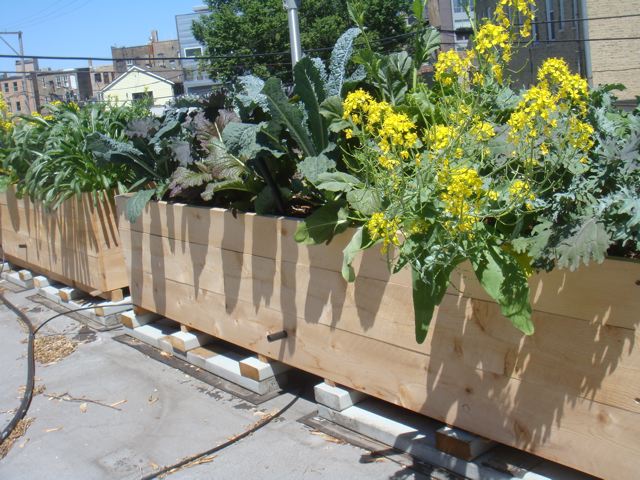
It's been unseasonably warm in the past few weeks. The rapini (or is that rapa) has gone to seed. It's nice to see that my cedar SIPs are working properly.


My test run of peat based potting mix (foreground SIPs) vs. coir (at top) is still going strong.


The tomatoes are off to a good start. Despite our tomato seedling glitch, I have tomatoes in 8 SIPs this year, all growing varieties I bought from Genesis Growers at Green City Market.

You'll notice that I've skipped the plastic bag mulch/UV cover and am using ordinary pine bark mulch. After seeing that the SIP used by the Montreal Rooftop Garden program uses wood mulch in place of plastic (as detailed in the instruction manual contained in a pdf found at this link), I decided it would be worth breaking with our normal procedure in order to eliminate some plastic. That discovery also led to my next change.


Earlier this spring, I surrounded my rubbermaid tub SIPs with long panels made out of 2x2 lumber, UV resistant brown tarps, and cedar fencing boards. There are a several advantages: I don't have to use a plastic bag to protect the tubs from UV; I can now roll a length of tarp over the top of a row of planters at the end of the growing season, offering protection against the winter elements; best of all it doesn't look like my rooftop is littered with plastic bags that are sprouting plants.


After stopping by to say hello and take some pics, H2 headed home with her herb starts.

Thursday, May 13, 2010

Using Coir to Start Seedlings: A Cautionary Tale

In previous years, I've successfully started large numbers of seedlings in peat based potting mix. This year, in an attempt to move away from peat, I switched to a coir/perlite mix.

For reasons that aren't entirely clear, things aren't working as I'd hoped. One of the reasons for this post is to let readers who were counting on me to start their peppers and tomatoes know that the plants aren't in the best shape. For all I know, the plants will recover when transplanted into a peat based potting mix. That's my hope. If you don't want to take that chance, you might want buy your tomato and pepper seedlings elsewhere.

First, the good news. The eggplants look incredible. Even better than what in previous years I'd started in peat based potting mix.

About half of the tomatoes and all of the peppers look unhealthy. It would be easy enough to say that the coir is to blame, as it's the major difference between this and previous years; but with all the glowing reports on the benefits of growing in coir, it could just be that I bought a bad batch. Or that someone put peanut butter in my chocolate. (Huh?)

I've sent out a sample of the coir to a testing lab, but the results won't be back for a while. The peppers look anemic, though with a recent addition of gypsum (to make up for the nutritional deficiencies of coir), there is some promising new growth. The tomatoes have some funny looking lesions and aren't as "bushy" as they've been in previous years.

If you're looking for another place to pick up a few seedlings, a couple places that sell interesting varieties come to mind.

Green City Market Farmer's Market (every Wed and Saturday)

Kilbourn Park Organic Greenhouse Sale (May 15,16, and 19)

I've been hardening off my seedlings, and for those of you who haven't been discouraged by my post, they'll be ready for pick up starting this Saturday, May 15th.


I'll add some pictures tomorrow when I get my hands on a camera.

Thursday, May 6, 2010

Testing and Amending Coir

I'm not giving up on coir yet......Our neighbor, Carol, has been growing greens successfully in 2 bucket SIPs using coir. That suggests to me that coir will wick water in the same way that peat does. One difference was that she bought her coir from a local source, Brew and Grow. The coir they sell is roughly double the cost of the stuff we bought from Rolanka.

I like beurmann's idea of sending out a sample to be tested for nutrient levels and excess salts. He left links to several local testing companies and generously offered to split the cost. The first test is on me, if this gets expensive I'd be happy to take him (you?) up on it.

One the same subject, thanks, too, to our friends at Homegrown Evolution for pointing me to a great, cheap testing lab for any kind of garden soil -- UMass Soil Lab. I tried calling them to ask if testing for excessive salts in coir was possible and was asked to leave a message in a full voicemail box.

I'm a little confused by what kind of test I need to have done. Take a look at one company's menu of testing options. Does coir even count as "garden soil"? A phone call to one of testing companies might clear things up.

:::

In any case, it looks like I'll need to amend my coir with garden gypsum and epsom salts to get a soilless mix that transfers nutrients to my plants. From "tapla" at the GardenWeb Container forum -
Sphagnum peat and coir have nearly identical water retention curves. They both retain about 90-95% of their volume in water at saturation and release it over approximately the same curve until they both lock water up so tightly it's unavailable for plant uptake at about 30-33% saturation. Coir actually has less loft than sphagnum peat, and therefore, less aeration. Because of this propensity, coir should be used in mixes at lower %s than peat. Because of the tendency to compact, in the greenhouse industry coir is primarily used in containers in sub-irrigation (bottom-watering) situations. Many sources produce coir that is very high in soluble salts, so this can also be an issue.
Using coir as the primary component of soils virtually eliminates the reasonable use of lime or dolomitic lime as a Ca source because of coir's high pH (6+). Gypsum should be used as a Ca source, which will also help eliminate problems associated with coir's low S content. All coir products are very high in K, very low in Ca, and have a potentially high Mn content, which can cause antagonistic deficiencies and interfere with the uptake of Fe.
He, "tapla", gives some specific directions on how to amend the coir later in the same thread -
OK - I like peat much better, but of course it's your soil. ;o) Add 1 level tbsp of gypsum per gallon of soil or a skinny 1/2 cup per cu ft. Because you should use gypsum as a Ca source in coir-based soils, you'll need to use MgSO4 (Epsom salts) as a source of Mg, and so the Ca:Mg ratio isn't so skewed that you create a Ca-induced (antagonistic) Mg deficiency. Use 1/8-1/4 tsp per gallon of fertilizer solution every time you fertilize, or every other week if you're attempting to insure nutrients via organic soil amendments.

More information that suggests that adding gypsum is the way to go -
Coconut coir, a by-product of the coconut industry, has been promoted as an alternative to peat moss in soil-less media. Sphagnum peat moss has long been a standard component of soil-less media, but some people have expressed concern that it is a non-renewable resource. Although it does not appear that world peat resources will be in short supply for a very long time [nevermind the habitat loss and release of sequestered carbon, ed.] , coconut coir may have characteristics that make it a useful component of soil-less media mixes. Coir has been considered to promote excellent plant growth but there are few rigorous studies that have compared it with peat moss control plants. However, ten years ago, Meerow (1994) found that growth of Ixora coccine was significantly reduced compared to growth in a sphagnum peat moss control. Vavrina (1996) found that there were no adverse effects of coir to tomato and pepper transplants, but a subsequent study in the same lab (Arenas et al., 2002) found that media with more than 50% coir had reduced growth compared to peat-grown control plants. They suggested that a high N immobilization by microorganisms and a high C:N ratio in the coir may have caused the reduced growth. Lopez-Galarza (2002) found that root development of strawberry plants grown in peat moss was better than in coir in some, but not all, studies. Handreck and Black (2002), in a comprehensive textbook on soil-less media, review the chemical and physical properties of coir dust that are being sold in Australia. They indicate that since all coir products have extremely high K contents and low Calcium contents, it is critical to add a source of Ca to improve plant calcium uptake. Since the pH is already close to 6, liming materials cannot be used because they would increase the pH above optimum. Handreck and Black says that “Therefore, all coir-based media must be amended with gypsum, which also overcomes their low sulfur status.” [emph. added] Ma and Nichols (2004) recently reported that the problems with coir extend beyond its high salinity. Their data indicate that high concentrations of phenolic compounds in fresh coir are at least partly responsible for the growth reductions observed in other studies. Several studies at the USU Crop Physiology Laboratory indicated that monocots grown in coconut coir were extremely chlorotic and stunted. The objective of this study was to see if there are differences among plant species and types of coconut coir compared to growth in sphagnum peat moss.

Monday, May 3, 2010

Round 2: Coir vs. Peat in a Sub-Irrigated Planter (SIP)


On April 12th, I planted four SIPs--shown at left in the pic above--with the same control group of greens--tatsoi, bok choy, chard, rapa--and fertilizer.

The variable was that each SIP had a different soilless mix. Three weeks later, the early results are in.


SIP #1 - 30% one yr old mix (coir/earthworm castings, peat) from my potato box experiment, 50% 3 yr old BAACTO (peat based) potting mix, 20% perlite.


SIP #2 - 70% Three year old BAACTO potting mix, 30% added perlite


SIP #3 - 40% Three year old BAACTO potting mix, 40% coir, 20% perlite.


SIP #4 - 70% coir, 30% perlite.

I bought the coir from Rolanka and reconstituted it with water. The wetted volume is what is referred to in the above formulas. According to the literature, it is a superior growing medium as well as an eco friendly substitute for peat. Which is why I want it to work.

After these initial tests, my sense is that, unfortunately, the coir doesn't perform as well as potting mix. A maximum of 40% coir seems to be a good bet. Of course this could change, it's still early.

We'll keep doing tests on other types of plants throughout our growing season.

Friday, April 30, 2010

Coir vs Peat in a Sub-Irrigated Planter (SIP): Three Weeks In

Planted on April 1, 2010. Photo taken April 22.

At left, collards in 70%coir/30% perlite. On the right, 70%peat/30%perlite.

We're wondering if the coir mixture is wicking at all. After a heavy rain, the coir SIP perked up, but the plants in the peat mixture continue to outpace it.

Stay tuned for further updates...
Bruce is testing other blends of coir+peat. For now, I'm extending our peat/perlite potting mix (on its third year) with a percentage of coir for current plantings...but not going the all-coir route.

Tuesday, March 30, 2010

Sub-Irrigated Chicago Rooftop Garden: New Approaches for 2010

We're making a few changes this year, large and small, to speed multiple SIP planting and help preserve diminishing peat bogs.

Using a large rubber band to secure the 5-gal SIP shower cap
Sounds obvious, but in the past we've used string or the more expensive zip ties. We'll see if rubber bands hold up under all that UV, though the position of these under the bucket lip should mean the sun won't bake them to smithereens. You need nimble fingers to use them, though.

(And kudos to the marketing person who named these rubber bands.)


Potting Mix: peat+perlite vs. coir+perlite

We want to move away from peat moss, which develops over millenia and, when harvested, releases massive amounts of carbon dioxide into the atmosphere.

We're going to make this experiment as exacting as possible, planting two peppers, two tomatoes, and two sets of greens side-by-side, one each in coir/perlite and the other in our old peat/perlite mix (of undetermined exact specifications).

Bruce's recipe is: 70% (by reconstituted volume) coir and 30% perlite.

We found a relatively inexpensive (including shipping) source for large blocks of coir at Rolanka. We've been buying the 5:1 compressed blocks. Four come bundled together, costing $58 delivered to Chicago. Each of the blocks, reconstituted with 6 gallons of water and combined with 3 gallons of perlite (from Anton's Nursery in Evanston, $20 for a 4 cubic foot/30 gallon bag or at Home Depot for $2/gallon), makes enough potting mix to fill three 5-gallon bucket planters (3 cubic feet of mix).


All those numbers can be summed up in one sentence: The coir/perlite mix is $5.50/cubic foot, about the same price as the peat based potting mix we've been using.


Cutting out exact-sized plastic rounds for the "shower caps
"
Sounds minor, but I formerly used an old form to score garbage bags and cut out shower cap circles. They were a little large and I always ended up trimming the extra skirt from the top of my SIPs. And yes the results looked raggedy.

I discovered the 16" diameter recycled Olive Garden salad bowl (garbage picking at that graduation party last year was a boon) creates a perfectly sized round for the 5-gal bucket SIP. You can cut a plastic circle out of anything waterproof--a soil bag, whatever. I like garbage bags because they're thin and flexible.


Water fill tubes
One of our local readers last year brought us a roll of polyethylene drip irrigation tubing, which we'll cut and use for fill tubes on the new SIP run this year. Generous person whose name we have misplaced: thank you!

We'll keep you updated on the results of our changes. If you're making any, let us know.