Showing posts with label earthbox. Show all posts

Tuesday, March 13, 2012

Near 80 Degrees F in Chicago March 14, 2012?

This 7-day forecast for Chicago freaks me out, I said to Art yesterday. A whole lot of very warm highs and now-very-low lows. Those temps are about a month early.

And he said: You're complaining about an extended growing season?

Hmmm. He had a point.
Hurry hurry off to Bruce's to pick up the 3-inch seedlings (above) he's been tending under lights. An almost-too-warm-for-cool-weather-greens world awaits them. I put them in front of the open windows in south sun to buck up a little. 


Today, on a day that feels like May, I recharged an Earthbox from last year, removing the top layer of potting mix and fertilizer and refreshing both....


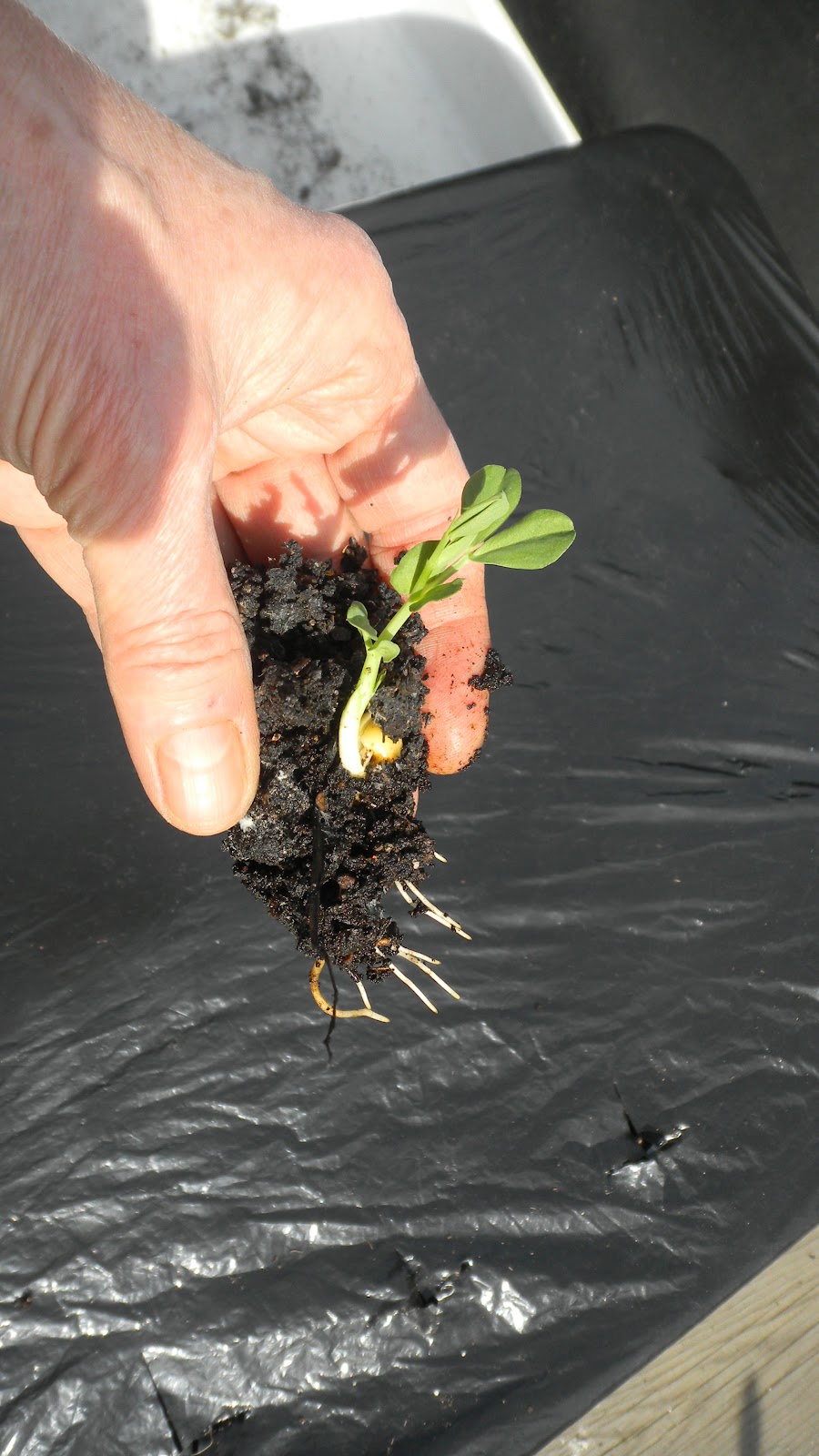
...in order to plant the sprouted pea seeds I started in some compost Feb 20 (check out those healthy roots).
 

People always ask what fertilizer we use
for spring plantings. This one.
In our second adopted Earthbox, lettuces.
Here they are, looking a little droopy in the hot sun, but they should perk up.

Are we ready for this year's weather? Who knows where's it's heading. Art screwed in the windbreaks on the cool-weather greens run to guard against infant-greens ravaging spring winds. Just in case.

Lunch break:
salad from the raised bed (top picture)

Taken out of context, 78 degrees on the roof made for a beautiful day.

Saturday, June 5, 2010

Au Revoir, Russ

Today we're saying goodbye to Russ as a GRG contributor. He was featured in a nice Chicago Magazine piece by Karin Horgan Sullivan in May 2009 and went on to have a bountiful harvest later that year.

Russ's roof in Sept 2009

He and Alyssa and their little sprout Hank will be spending the next eight weeks strolling through gardens like this one. Yes, they're off to Paris for a couple months before returning to Minneapolis, where they'll live.

Bon voyage, Russ, Alyssa, and Henry!

We hope you'll return to blog in 2011 from your next verdant roof.

Wednesday, May 6, 2009

Welcome Chicago Magazine Readers

In the May edition of Chicago Magazine, there's a nice article on urban gardening, "Salad Days". I want to publicly thank author Karin Sullivan for including my rooftop garden in her story. When we met last year and she told me she was thinking of writing a short piece on growing food in city gardens--and wanted to showcase one of our rooftop gardens--I was pretty excited about the prospect of other people learning about what we're doing.

I have to say that I’ve learned a lot from Bruce and Heidi (my fellow Green Roof Growers) over the past year. Their roof gardens are much more involved – and larger – than mine but I think Karin wanted to show that someone with very little knowledge (like me!) could have success in a very limited time. I hope that came through in the article.

Whenever they see the garden, people seem to ask me the same questions. Here are answers to the most common ones:

I grow in Earthboxes; a basic one costs about $30 on the EB website.

I used Miracle Grow organic potting mix with Foxfarm’s organic fertilizer last year and am re-using the same potting mix in this year’s garden.

Last year, I used starter plants purchased at both Gethsemane and Home Depot. This year, all of the starts are grown from seed (thanks much Bruce).

The Earthboxes (as well as all sub-irrigated planters – aka SIPs) will use less water than conventional gardening since nothing is wasted.
"Our maintenance-free, award-winning, high-tech growing system controls soil conditions, eliminates guesswork and more than doubles the yield of a conventional garden- with less fertilizer, less water and virtually no effort."
One of the major upgrades I’m adding this year is an automatic watering system so I can go out of town without worrying that my plants will suffer.

My rooftop was built for decking and can carry the weight of the boxes (about 50 lb each). Before you put anything on any roof, please consult with a structural engineer or other building professional to confirm that your structure can handle it.
Our site has a lot of information that can get you started. I’ll also be posting some updates to this year’s garden as time goes on. If you need anything else or have any ideas, please feel free to post a reply to one of the posts here. Thanks for stopping by.


[I changed the posting date from April 14th to May 6th so it stays "stuck" at the top of the site for a while. - B.]

Thursday, April 16, 2009

Three-Season Growing in Chicago: First Harvest of 2009

Here's an idea for anyone who yearns to start growing food before the ground can be worked in March.

We've harvested four big bowls of cool-weather greens in the last couple weeks. With Chicago's temperatures swinging wildly between 80 and 40 F, the greens alternate between getting a shot of growth-spurring heat and the cold they thrive in.

This picture was made April 26 (the SIPs look a little light since I've started regularly cutting for meals). Greens deliver near-instant gratification. When you plant a tomato, it's an act of faith that two to three months later you'll be reveling in flavor.

The Red Velvet lettuce from Seed Savers below is just coming into its own. I wonder if it will ultimately produce the very dark red lettuce shown at the link.

It's a thrill to stop buying organic greens shipped in from California (though we're lucky to have access) and instead tuck into a bowl of 12 different chards, kales, lettuces, mustard, arugula, and cress, chopped and doused with the house dressing: olive oil/Dijon/chardonnay. These young greens are so tender they don't need steaming.
We're lucky that Bruce started our cool-weather plants under lights, so they'd settle in and start producing quickly. The direct-seeded versions in our tiny in-ground garden bed are lagging behind a bit.

It's worth noting that anyone who wants to try growing in SIPs, including earthboxes, can start these beauties from seed inside in February before planting and setting them out in late March/early April. In Chicago, this extends our growing season by at least 6 weeks and generates a steady supply of phenomenal green food.

Next year I think we'll try starting even earlier...