Showing posts with label fertilizer. Show all posts

Tuesday, June 12, 2012

Why We Grow Tomatoes 2012

(a West Virginia heirloom apparently having nothing to do with the cereal company)

After focusing on work only for the entire month of May I finally started planting tomatoes around the first of June and haven't stopped since.  Look at that photo, an incredible single plant growing in a sub-irrigated container (SIP) on our roof in Chicago, begging to be picked. Hold that image as we move through the summer months.

Did I say it was hot on the roof? Temps at or near 90 for four days translated to this on the growing deck:

We moved food production to the roof because of burgeoning shade on the ground. With these temps we may have to introduce shade on the roof. Most people seem unaware of the bizarre weather--is it because they don't grow food?  I can tell some people think I'm BEING NEGATIVE. My planting notes reminded me we had an utterly strange string of hot weather in March, including about nine days in the 80s and one near 90. Facts are facts. Happily, the weather broke this morning. But before it did, this gardener's friend put up a nice umbrella for me to plant under.

But let's back up. Bruce tended and befriended the tomato, eggplant, and pepper seedlings. He did a fine job and this year's crop is extraordinarily beautiful.

Look at that biomass from a handful of seeds.


As usual, we added perlite to our potting mix from previous years to lighten it up.

All the usual fertilizers and lime for tomatoes.

We've retrofitted most of the SIPs from the original damp-mix-filled wicking cup (large hole in center) to the wicking tapes.

After a backbreaking bunch of planting, Art raised the soil bin six inches off the ground, easing the load on my lower back. A miracle.

Many new varieties set for this year, and I'm optimistic it'll be a solid season. The white tubing is Art's auto-water system, essential in this hot weather.

The bees love it when we water, gathering round the moving stream and crawling into the holes to drink when the flow stops.

I pulled the peapods and lettuces, which grew like crazy and then spun out in the heat, from the two earthboxes and laid in more fertilizer. Bush beans at left, a tomato and tomatillo (thanks, Bruce) sharing the EB at right.

I'm not finished yet but getting closer. Already tasting the pingtung long eggplant,Jimmy Nardello peppers, and BLTs.

This is why we grow tomatoes


Tuesday, March 13, 2012

Near 80 Degrees F in Chicago March 14, 2012?

This 7-day forecast for Chicago freaks me out, I said to Art yesterday. A whole lot of very warm highs and now-very-low lows. Those temps are about a month early.

And he said: You're complaining about an extended growing season?

Hmmm. He had a point.
Hurry hurry off to Bruce's to pick up the 3-inch seedlings (above) he's been tending under lights. An almost-too-warm-for-cool-weather-greens world awaits them. I put them in front of the open windows in south sun to buck up a little. 


Today, on a day that feels like May, I recharged an Earthbox from last year, removing the top layer of potting mix and fertilizer and refreshing both....


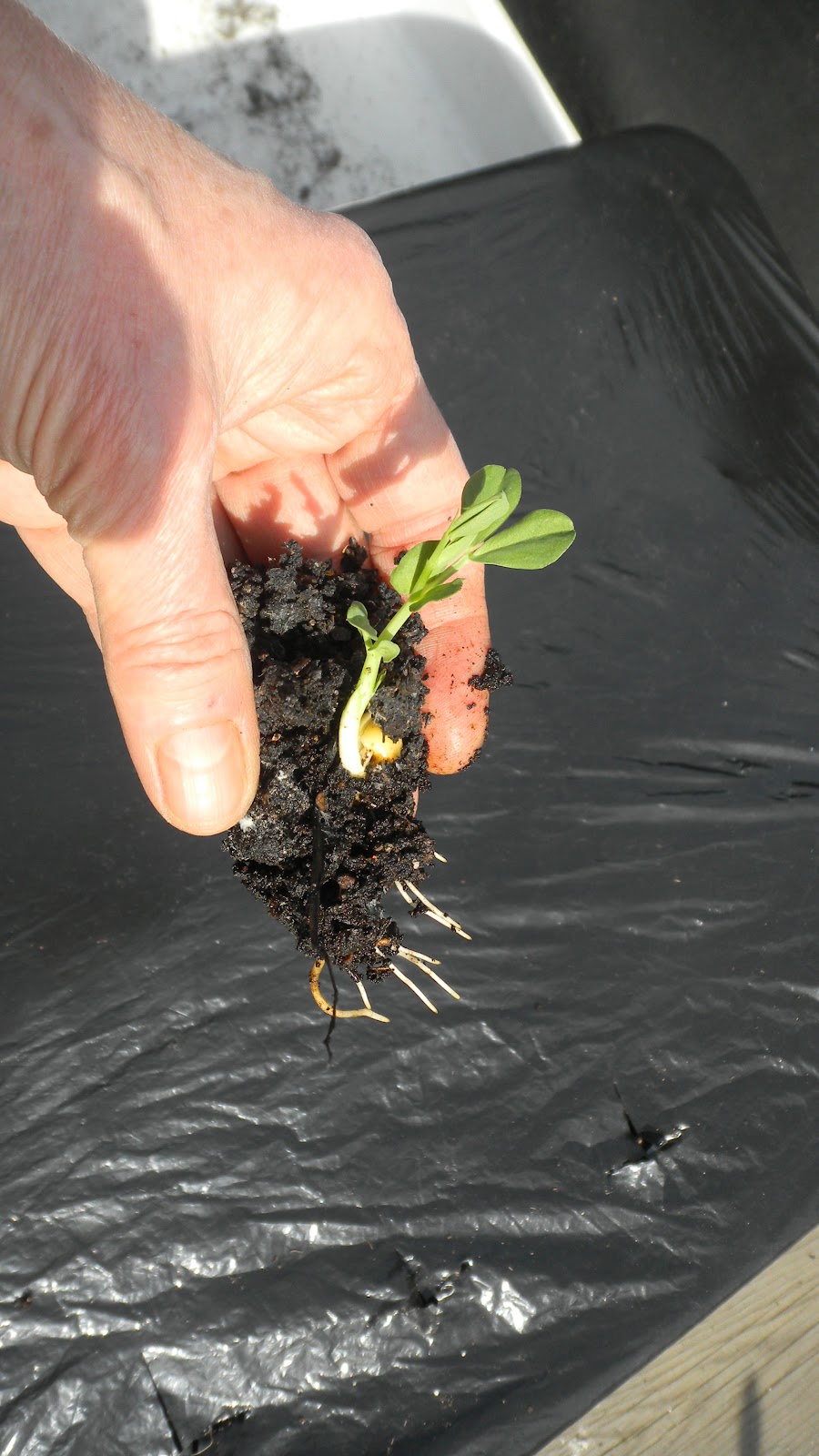
...in order to plant the sprouted pea seeds I started in some compost Feb 20 (check out those healthy roots).
 

People always ask what fertilizer we use
for spring plantings. This one.
In our second adopted Earthbox, lettuces.
Here they are, looking a little droopy in the hot sun, but they should perk up.

Are we ready for this year's weather? Who knows where's it's heading. Art screwed in the windbreaks on the cool-weather greens run to guard against infant-greens ravaging spring winds. Just in case.

Lunch break:
salad from the raised bed (top picture)

Taken out of context, 78 degrees on the roof made for a beautiful day.

Friday, January 22, 2010

Rat-Proof Composting + Compost Tea for SIPs

Today I'm interviewing my partner Art on his rat-proof composter, which he also designed to produce compost tea to feed the SIPs.

Here are 333,000 ideas on how to keep rats out of your compost. And here is Art's:
What motivated you to build the rat-proof composter?
Apple cores and various vegetable remains sitting on the exhaust manifold under the sheltered hood of my truck. Rats would take from our open compost heap and go picnic in peace.

After we decided to ditch our open heap 5 years ago (H2: we had an open heap for 15 years), I purchased a commercially produced, heavy-duty plastic compost bin to keep the rats out.

Here's what happened to it.
In other words, plastic doesn't deter rodents.

Do you have more rats now than you did 20 years ago?
More rat activity anyway. Over the last few years massive rehab and tear-downs were occurring in our neighborhood. This is extremely disruptive to rat patterns, sending rodents out of their hidey holes into a newly gentrified world. Our street has also become a sort of club+restaurant row, with 6 new restos in the past 5 years.

What got you thinking about this raised composter?
I had a couple of steel plaster tubs I'd purchased at a construction auction a while back and decided to put them to alternate use. I positioned the composter off the ground both to discourage the rats a little (though they're capable climbers) and because I wanted it to produce compost tea.

Most people don't add compost to the growing medium for SIPs (at least we don't--they seem to require a non-organic mix to maintain their wicking capability), but you can add liquid compost tea to the water reservoir for the plant roots to take up.

So how did you approach the project?
I put the two plaster tubs together in a clamshell arrangement using a piano hinge and set the composter in a stand 3 feet off the ground, with one end about 4 inches lower than the other to facilitate gravity flow of rainwater passing through the compost. I coated the interior of the bottom tub with linseed oil to prevent rust.

Then I built a frame (with 4x4 leg posts) to sit it in and drilled a series of quarter-inch holes along the low underside of the bottom tub, where the liquid would gather and drip through.

Lined up with the holes on the bottom tub, I attached a rain gutter that's pitched toward a compost tea reservoir sitting on the ground. It's made from a kitty litter container I found on the street.

How does the compost get oxygen?
I put a handle on the top plaster tub and also cut an access door into the end where we add kitchen scraps (H2: no meat, bones, or fat--maybe we have vegan rats). The hole is a little larger than the old tupperware bin we keep near the sink to collect compost bits.


We open the composter to turn the heap and also when it rains, so the moisture can get to the contents. When it's not raining, we leave it open to dry and oxygenate the heap. We close the lid at night, when rats feed.

How hot does it get in there?
Last summer temps got as high as 120F. I painted the exterior of the tubs black to enhance the heating and drilled a hole in the lid through which we slide a thermometer.

What about that handsome wood surround you made?
Mainly aesthetics and to create a semi-enclosed area underneath for storing buckets of unfiltered compost tea. The amount we get depends on how much rain we have.

Tell us how you manage the compost tea
It's a gravity feed system that drains into the kitty litter container, to which I attached a valve and a clear piece of tubing so I can tell when it's time to empty the container into the back-up buckets.
To get tea, we position the container on a higher spot and drain it into a 5-gal bucket, using a sieve to remove any large bits.
Then the filtered tea goes back into the container and we use a funnel to send it into recycled two-liter bottles, which we transport in buckets (we use a lot of buckets around here) to the roof.

Last season H2 gave compost tea our large 6-gal in 7-gal SIPs, which grow tomatoes and eggplant, delivering one two-liter bottle per SIP via the fill tube. Since it was a wet summer, we had enough tea to provide three doses, one each in June, July, and August.

H2 doesn't give straight tea--she sets down a two-liter bottle next to each SIP and adds it over several days to the water already in the reservoir. Here's an eggplant diggin' the tea.

What do you do with the compost?
H2 shovels it out onto our small in-ground bed that gets sun enough to grow things. It's a richly endowed garden bed, with about 5 inches of compost applied each fall. Here's a shot from last spring.
So did you stop the picnicking rats?
Yes! There was no evidence of rat buffets under the hood of my truck last summer. I'm not naive enough to think I can ever completely outsmart Chicago's Norway rats. Even though the link says they can gnaw through cinderblock, we'll see about steel.

H2 final note: Art has set up a trapline around the courtyard. Don't let him fool you--he will never stop trying.

Wednesday, April 8, 2009

Making a 10-10-10 Organic Fertilizer

As I said in a comment to H2 in the previous post on Blending Fertilizer, the way Science--in the guise of N-P-K numbers--looks down at gardening is a problem. My hope is that by talking about how these formulas are put together some of their (undeserved) power will fade.

The reason for this post is that I want an inexpensive basic 10-10-10 slow release organic fertilizer, and I can't find any. Maybe for good reason, I don't really know. I do have the components, courtesy of a clearance sale at a local garden store, to make my own blend.

*******5.22.10 - I've since found out that the ideal ratio for NPK is 3:1:2.
3:1:2 ratio fertilizers don't supply 'excessive' N. Plants use about 6 times more N than P, so 1:1:1 ratio fertilizers actually supply far more (excessive) P than plants can use in relation to N. The 15-30-15 you suggest actually supplies 12x as much P as plants can use in relation to N, unnecessarily raises the electrical conductivity and level of total dissolved solids of/in the soil, unnecessarily raises pH, and makes it more difficult for plants to absorb water and the nutrients dissolved in water - particularly Fe and Mn.
This post is still useful. I'll use the same methodology to make a 9-3-6 fertilizer.*******

Here's how I do it.

Home gardeners and their suppliers are trained to think of volume, not weight, when it comes to fertilizer, i.e. 3 cups of 10-10-10 fertilizer per Earthbox™/18 gallon SIP. Farmers and Growers measure fertilizer by the weight of the available (to the plants) N-P-K, expressed as a percentage of the total weight of the fertilizer. Those are the 3 numbers you'll find on the back of all fertilizer bags. So to come up with a blend, you'll need to use weight to make a batch with the proper proportions and then measure out the amount to use from your blend by volume (in cups).

My goal is a 10-10-10 fertilizer. Meaning 1 pound* of fertilizer with .10 lb of N available, .10 lb of P, and .10 lb of K. The basic math can be used to create any mix you'd like.
* Chemistry can be very precise. The way it plays with the meaning of words is confusing as hell. Remember that 1 lb of delivered NPK rated 10-10-10--expressed as a percentage of the total weight and available to be used by the plants--will weigh more than 1 pound. We're determining the weight of the available NPK, not the total weight of the blend.

I have Miracle-Gro Organic 7-1-2, Espoma Triple Phosphorus 0-46-0, and Espoma Epsom Plus 0-0-22. Following the basic formulas laid out at this site, it's possible to combine these into a 10-10-10.

You can skip down to the end if you want the answer. In the meantime, I'm going to show my work.

The numbers behind the making of 10-10-10.

To simplify(!) the math, I'm basing this all on 1 pound of fertilizer.

Start with the most complete element, the 7-1-2. It provides .07 lb of N per 1 pound of fertilizer. To get .10 lbs of N, I'll need .10/.07= 1.43 lbs of 7-1-2.

In that 1.43 lbs of 7-1-2 there is 1% of P or .01 x 1.43=.0143 lbs available. We need to credit ourselves for the P supplied in the 7-1-2, 1%, so we subtract .0143 lbs from the .10 lbs required, leaving a deficit of .0857 lbs to be made up using 0-46-0. We divide the .0857 lbs needed by 46%, or .46, to get .186 lbs. That is the amount of 0-46-0 we need to add to our blend to get .10 lb of P available.

Finally we need to account for the K supplied by the 7-1-2. In the 1.43 lb of 7-1-2 there is 2% of K or 1.43 x .02= .0286 lbs. Subtracting that from the .10 lb of K needed leaves a deficit of .0714 lbs to be made up by the 0-0-22. So divide .0714 by .22 to get .323 lbs of 0-0-22 necessary to make .10 lbs of K available to the plants.

Now we have the formula for 10-10-10, delivering 1 lb of N-P-K:

1.43 lbs of 7-1-2
.186 lbs of 0-46-0
.323 lbs of 0-0-22

To use this formula I converted lbs to grams by multiplying each of the amounts by 454. (454 grams = 1 lb). This let me easily weigh them on my kitchen scale, which I enclosed in a zip-lock bag to keep it clean.

I weighed each component separately, adding to a bucket as I went along. As I was measuring them, I made a point of weighing 1 cup of each. This way I can recreate the recipe with a cup instead of a scale.

One cup of 7-1-2 weighs 165 grams
One cup of 0-46-0 weighs 320 grams
One cup of 0-0-22 weighs 390 grams


The Simple Answer

To make a little more than 4.5 cups of 10-10-10

4 cups of 7-1-2
.25 cup of 0-46-0
.375 (3/8ths) cup of 0-0-22

To make 22 cups of 10-10-10.

19 cups of 7-1-2
1.25 cups of 0-46-0
1.80 cups of 0-0-22

Because of rounding errors, i.e. I turned 3.93 cups into 4, the amounts don't scale exactly. You can vary the quantity. Just keep the ratios between them the same.


Each of my thirty SIPs needs 3 cups of 10-10-10, so I'll be making this a few more times this spring.

Tuesday, April 7, 2009

Making a Custom Fertilizer Blend

[Newer post with an easier to use formula, here.]

Fertilizer has been a sticking point for a while. I could never shake the suspicion that all the talk online, and from Official Garden people, never really explained what those numbers meant. More to the point, how do I combine them to get what I want--which method do I use? Do I just add the numbers together? I managed to pass a chemistry class in college--a while ago--why can't I figure this out!?
I get the basics. N-P-K + vital nutrients; 3 cups of organic or 2 cups of petro-chem slow release fertilizer rated between 5-5-5 and 15-15-15. Blah, blah, blah. And it's not just N-P-K that's important. Ideally, all the nutrients would come from soil that we "grew" via compost.

The catch is that we're using closed containers that are watered from below and use peat/coir as their growing medium--in order to wick moisture properly--and as a result need outside nutrients. The loop is not closed. Because we don't want to spend a lot of money to reinforce our roof structures, we can't use heavy composted soil; light weight medium like peat and coir are our only options.
So.

We use organic--with a few exceptions--which limits our choices, has lower nutrient levels, and is more expensive. Unless there's a sale.

A local gardening center was changing their product line and in the process getting rid of all their Espoma products at 50% off. I bought plenty. If you're in Chicago, you might want to see if they've any left.

With all these different nutrients, I have a chance to make my own blend. Let me back up a bit and say that in the past we've used some Miracle-Gro Organic 7-1-2. Plenty of negatives: Big company that makes most of it's money polluting; Not balanced- too much N, not enough P and K. I think it showed in our results. Add to that our local supplier of Bradfield Organics stopped selling large bags. So I thought, this year I'm going to try mixing my own. How hard could it be? A few clicks with google and it'd be sorted out.

Not true. And so the reason for this post, which is basically a copy of an email I sent to H2, my co-blogger.

To begin, I decided what blend I wanted to end up with, and how much I needed.

For my 2 Mammoth Melting Pea SIPs, I wanted 6 cups of slow release 5-10-10. (Peas/beans fix nitrogen, so the N should be lower. And don't forget the pea inoculant.)

My base, and all the nitrogen (N), came from Espoma 5-3-3. This means 5% (by weight) of N, 3% P, and 3% K are available to the plant. I also have a bag of Phosphorus (P) from Espoma 0-46-0, as well as Potassium (K) from Espoma 0-0-22

The 5-3-3 Plant-tone (pdf) has all the trace elements.

Now the math. This link is the first place that I have seen a detailed explanation. Fortunately it's not that complicated. It does make it clear to me that all the people I've talked to/read about how to combine fertilizers really had no idea how to do it and were blowing smoke. Home gardeners just don't do this kind of thing.


A recipe to make 1 pound, roughly 3.5 cups, of 5-10-10.

Meaning 1 pound of fertilizer with .05 lb of N available, .10 lb of P, and .10 lb of K. The basic math can be used to create any mix you'd like.

All the fertilizer numbers are by weight, not volume.

The trick is to remember that 1 lb of delivered NPK rated 5-10-10--available to be used by the plants--will weigh more than 1 pound. We're after the weight of the NPK, not the total weight.
• Start with the most complete component, one with a little of all three.

By definition 1 lb of 5-3-3 has .05 lb of N available.

• The 1 pound of 5-3-3 also has .03 lb of P available. I subtract this from the .10 lb that I require, leaving a deficit of .07 lb. A pound of 0-46-0 has .46 of a pound of P available. I don't need that much, only .07 lb. The total amount of 0-46-0 to add to the mix is .07 divided by .46 or 0.15 lb.

• The 5-3-3 has .03 lb of K available. I subtract this from the .10 lb required, leaving a similar deficit of .07 lb. A pound of 0-0-22 has .22 of a pound of K available. I only need .07 lb. So the total 0-0-22 added to the mix is .07 divided by .22 or 0.32 lb.

Result: 1 lb of 5-3-3 plus 0.15 lb of 0-46-0 plus 0.32 lb of 0-0-22 gives me 1 pound of 5-10-10.

Like I said it's confusing. If you put the blend on a scale, you'll have 1.47 lbs of mix to each pound of the actual nutrients delivered. But that's how fertilizer is "measured".

Because SIPs/earthboxes are fertilized by volume not weight, I'll have to estimate how much to use. My SIPs need 3 cups per box. I'll be mixing my fertilizer by weight and applying it by the cupful.

[Newer post with an easier to use formula, here.]

Edited on 6.5.09

To use the above formula, I measured the density of the three components.

•
3 cups of Espoma 5-3-3 weighs 1 pound (454 grams)
•
One cup of 0-46-0 weighs 320 grams
• One cup of 0-0-22 weighs 390 grams

To make approximately 3.5 cups of 5-10-10 fertilizer, I need:
.15 x 320=.20 or 1/5 th of a cup of 0-46-0
.32 x 390 = .375 or 3/8ths of a cup of 0-0-22
3 cups of 5-3-3