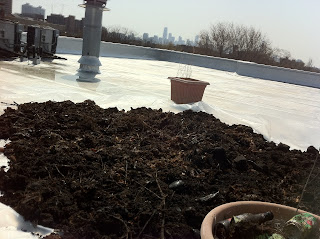
Today I'm interviewing my partner Art on his rat-proof composter, which he also designed to produce
compost tea to feed the
SIPs.
Here are
333,000 ideas on how to keep rats out of your compost. And here is Art's:
 What motivated you to build the rat-proof composter?
Apple cores and various vegetable remains sitting on the exhaust manifold under the sheltered hood of my truck. Rats would take from our open compost heap and go picnic in peace.
After we decided to ditch our open heap 5 years ago (H2: we had an open heap for 15 years), I purchased a commercially produced, heavy-duty plastic compost bin to keep the rats out.
Here's what happened to it.

In other words, plastic doesn't deter rodents.
Do you have more rats now than you did 20 years ago?More rat activity anyway. Over the last few years massive rehab and tear-downs were occurring in our neighborhood. This is extremely disruptive to rat patterns, sending rodents out of their hidey holes into a newly gentrified world. Our street has also become a sort of club+restaurant row, with 6 new restos in the past 5 years.
What got you thinking about this raised composter?I had a couple of steel plaster tubs I'd purchased at a construction auction a while back and decided to put them to alternate use. I positioned the composter off the ground both to discourage the rats a little (though they're capable climbers) and because I wanted it to produce compost tea.
Most people don't add compost to the growing medium for SIPs (at least we don't--they seem to require a non-organic mix to maintain their wicking capability), but you
can add liquid compost tea to the water reservoir for the plant roots to take up.
So how did you approach the project?I put the two plaster tubs together in a clamshell arrangement using a piano hinge and set the composter in a stand 3 feet off the ground, with one end about 4 inches lower than the other to facilitate gravity flow of rainwater passing through the compost. I coated the interior of the bottom tub with linseed oil to prevent rust.
Then I built a frame (with 4x4 leg posts) to sit it in and drilled a series of quarter-inch holes along the low underside of the bottom tub, where the liquid would gather and drip through.
Lined up with the holes on the bottom tub, I attached a rain gutter that's pitched toward a compost tea reservoir sitting on the ground. It's made from a kitty litter container I found on the street.
 How does the compost get oxygen?
I put a handle on the top plaster tub and also cut an access door into the end where we add kitchen scraps (H2: no meat, bones, or fat--maybe we have vegan rats). The hole is a little larger than the old tupperware bin we keep near the sink to collect compost bits.

We open the composter to turn the heap and also when it rains, so the moisture can get to the contents. When it's not raining, we leave it open to dry and oxygenate the heap. We close the lid at night, when rats feed.
 How hot does it get in there?
Last summer temps got as high as 120F. I painted the exterior of the tubs black to enhance the heating and drilled a hole in the lid through which we slide a thermometer.
What about that handsome wood surround you made?Mainly aesthetics and to create a semi-enclosed area underneath for storing buckets of unfiltered compost tea. The amount we get depends on how much rain we have.
Tell us how you manage the compost tea It's a gravity feed system that drains into the kitty litter container, to which I attached a valve and a clear piece of tubing so I can tell when it's time to empty the container into the back-up buckets.

To get tea, we position the container on a higher spot and drain it into a 5-gal bucket, using a sieve to remove any large bits.

Then the filtered tea goes back into the container and we use a funnel to send it into recycled two-liter bottles, which we transport in buckets (we use a lot of buckets around here) to the roof.

Last season H2 gave compost tea our large
6-gal in 7-gal SIPs, which grow tomatoes and eggplant, delivering one two-liter bottle per SIP via the fill tube. Since it was a wet summer, we had enough tea to provide three doses, one each in June, July, and August.
H2 doesn't give straight tea--she sets down a two-liter bottle next to each SIP and adds it over several days to the water already in the reservoir. Here's an eggplant diggin' the tea.
 What do you do with the compost?
H2 shovels it out onto our small in-ground bed that gets sun enough to grow things. It's a richly endowed garden bed, with about 5 inches of compost applied each fall. Here's a shot from last spring.
 So did you stop the picnicking rats?
Yes! There was no evidence of rat buffets under the hood of my truck last summer. I'm not naive enough to think I can ever completely outsmart Chicago's
Norway rats. Even though the link says they can gnaw through cinderblock, we'll see about steel.
H2 final note: Art has set up a trapline around the courtyard. Don't let him fool you--he will never stop trying.