Saturday, June 9, 2012

Spriky and the 2-Liter SIP Comic


We love that people are being exposed to the idea of recycling water bottles and gardening in them. Perfect project for kids, families, adults and small space gardening!

Spritzer, a company in Malaysia did a really cute comic based on my original 2-liter SIP infographic that I designed and posted on GRG last March. I love Woan Ling's illustrations... as an Information Architect, Art Director and gardener I thinks she did a beautiful job on translating the instructions and Spriky the little water drop does a great job of teaching us how to make a SIP. 

Click here to see the original post and more environmentally friendly comics with Spriky.

Stay tuned... we'll be doing more SIP infographics on GRG and at The Singing Seed on Facebook!

Please share!


Tuesday, June 5, 2012

New Hive in the Hood

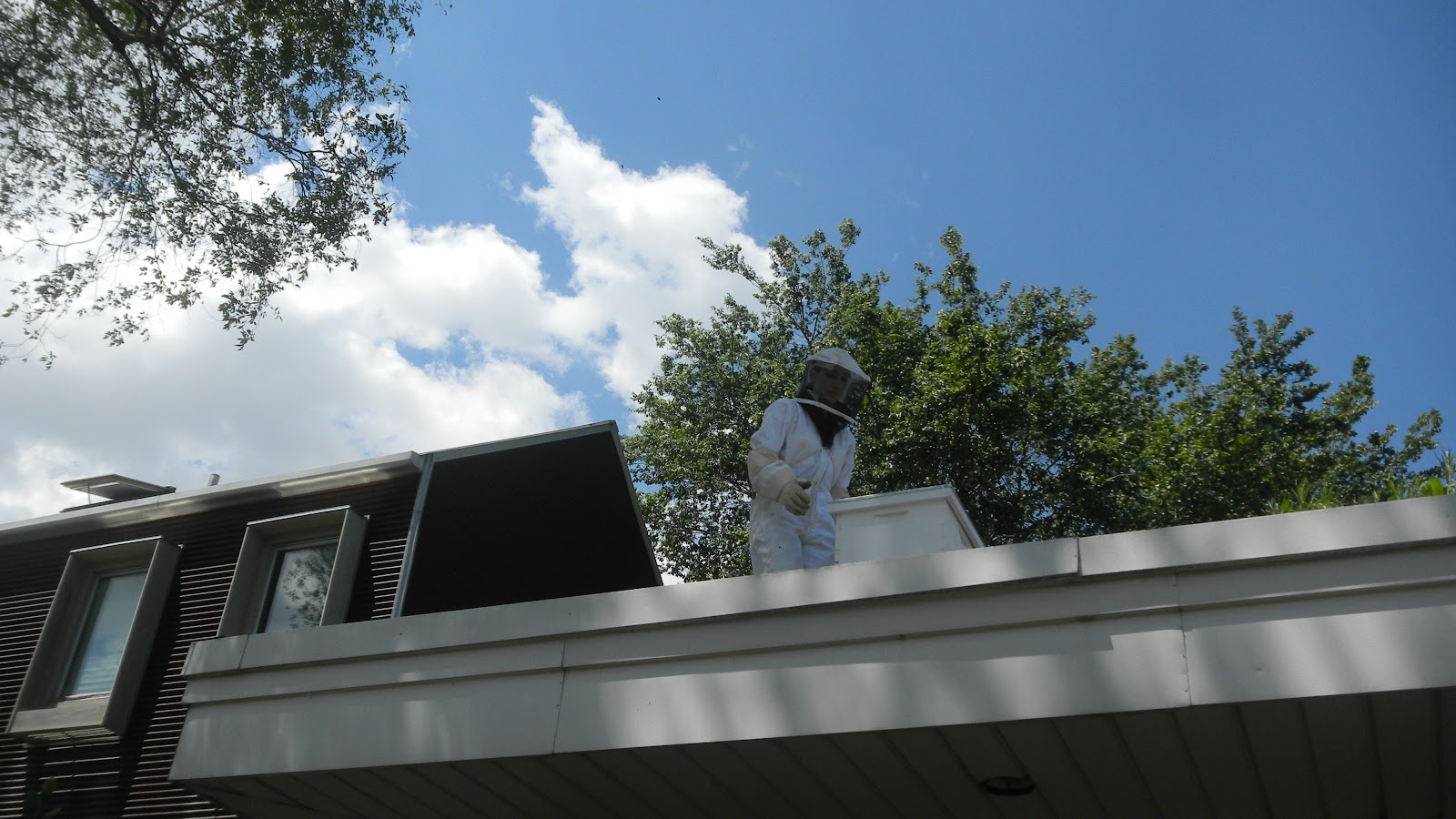
Bruce has a beehive, nice complement to his expanding agrarian plot in Chicago. Tended by volunteers from the Garfield Park Conservatory (click on the link to see the horrendous damage from last year's hailstorm), the hive sits on the roof of his garage.

When I stopped by last week to pick up the beautiful tomato/eggplant/pepper starts that Bruce has been tending, the crew was cracking the hive for a closer look. All is well.

Trimming a large tree means this eastern garden bed gets a lot of nice light. It's filled with herbs including white borage that popped up from last year, and will soon host a couple tomato plants.

Speaking of bees, over on our roof Noam was surprised to find we were missing two queens. Undaunted, we ordered more from Simpsons in Ohio. They were shipped with clear instructions for the post office to hold for Noam's pick-up, but instead our delivery person dumped them through the mail slot.  The queens are currently caged but in position, their pheromones wafting through the two hives. We'll be underway again soon.

Sunday, June 3, 2012

Hot May in Chicago: Spring Greens Report

Heat changes everything about spring growing. When nice steady cool temps are replaced by spikes in the 90s, cool-weather greens wilt and sag unhappily and flavor starts to distort. These Burpee organic lettuces were stunning though.

Check out this chart of highs and lows in Chicago for May 2012. Yikes. We broke a record on Memorial Day with 97 degrees and had many more days far hotter than normal. Unsettling.

Amish Snap Peas from Seed Savers Exchange 
Got these seeds germinating in the unheated greenhouse in February. The nighttime cold/daytime greenhouse heat of trapped sun cracked 'em right open. We've had a beautiful harvest.

Braising greens (Hudson Valley Seed Library)
gone to seed

Aztec Spinach
First year for this beautiful leaf with a nutty flavor. Bruce was over for a salad last week and swore it was lambs quarters. They have a lot in common. Plus, does this doesn't look anything like...
...this photo of the seeds I ordered?


Perpetual spinach-chard
This yummy green gets leathery when the weather gets hot, but it's a spring standby at our house. Here's what Bountiful Gardens says:
Description: (1869) Rare, fine old European strain of Swiss Chard. Smaller smooth dark-green leaves, small mid-ribs. Frost and bolt resistant, needs water in a dry spell. We saw whole fields under cultivation in England.

Agretti 
Officially one of my favorite greens. This year we're eating, not growing seeds, and does this ever pick nicely. Pinching off delectable end bits triggers a double branch to form. 

These chrysanthemum greens taste like an evergreen tree smells,
and they're budding up to white flowers. They make any salad sparkle.

Mmm. With the hot temps my cutting board
won't be filled with these much longer.

Malabar Spinach 
Just started eating these substantial spinach-y leaves (thanks to Debbie who swapped me some seeds). They've been languishing on the roof in their little cups. Today I pulled bolted greens out of three yellow SIPs, removed the fertilizer, and planted these. Cornell says:
The leaves from this heat-loving vine have a mild flavor and are used like spinach in salads and cooking. Extremely frost-sensitive. It creeps when temperatures are cool, but leaps when the mercury hits 90 F.
 

We hope the Malabar leaps up our arched trellis this summer...


Tuesday, May 22, 2012

Lunch From the Garden


Last week I had a lunch meeting with my friend Cassandra. She set a fine table and we ate alfresco on her back porch. A perfect Friday afternoon. I brought a salad of Black Seeded Simpson, Romaine lettuce, Rouge d'Hiver and tender pea shoots. Fresh chunks of feta cheese, pita bread, hummus, and poppy seed dressing accompanied the meal.

Delicious food certainly makes a meeting lots more fun.


I harvested our salad this morning from this bed, one of three rows. These winter sowed lettuces I planted late October 2011 are still being consumed today. Amazing that these plants have been in the ground for 6+ months. This 12' salad bed provided food for our family, friends, and to some who've lost their jobs.

I try and plan ahead... gardening is all about timing. To keep a fresh supply of greens on the table I planted another bed (see below) of chard, bok choi and kale early April. They'll be on the family menu in the next few weeks. After this harvest, I'll plant tomatoes, herbs and warm weather greens in the same bed.


Luckily I planted extra bok choi... the vegetable weevils thought the bok choi was delicious too!

Wednesday, May 9, 2012

Transplanting Herbs, Tomatoes, Peppers

 
Cinnamon basil, English sorrel, summer savory

It was 85 (!) in Chicago last week when I went over to Bruce's to transplant herbs from their starting containers into larger ones. Given the bizarre temperatures, I transplanted a few but decided to bring most of them home to plant directly into the south-facing window boxes they thrive in.

Basil for everyone 
(you can never have too much or too many varieties)
 
Sadly, we had zero germination 
on the culantro (ngo gai)

Poor germination too on the Renee's Garden free seeds Debbie shared. These were originally donated to a children's garden program. 

Sure hope those kids had better luck than we did.


Tomatoes and peppers, still under lights last week but now being hardened off in preparation for planting out into SIPs. Who the heck knows when the last frost date in Chicago is anymore. It might have been 4 months ago.

Lettuces in an Earthbox on the roof. Look at those colors.

Saturday, May 5, 2012

Glazed Strawberries

Thanks to ngmpix for the photo.
I made these the other day, a recipe/technique from Jacques Pepin, and walked around the neighborhood giving them away.  The contrast between the thin hard candy shell and the ripe strawberry makes for a nice treat.


Ingredients

  • 1 cup sugar
  • 1/4 cup water
  • 6 to 8 drops lemon juice or 1/2 tsp creme of tarter mixed in 1 tsp of cold water
  • 1 pound ripe strawberries (conventional are full of pesticides, so try to use organic)


Oil a tray very lightly. If the strawberries are not clean, wash them gently and dry them thoroughly.

To glaze the berries: Put sugar and cool water in a small saucepan. Cook over medium heat until a candy thermometer registers between 310°F and 320°F degrees, the 'hard-crack' stage.  This will be about 15 minutes after the mixture comes to a boil.  To check the temp without a candy thermometer dip a teaspoon in the mixture, lift it and dip in a glass of cold water right away. If the mixture sets hard on the spoon, it's at the hard-crack stage.

An unlined copper pan--and who doesn't have one of those laying around--tends to prevent sugar from crystallizing. If (!) unavailable, add 6 to 8 drops of lemon juice/creme of tartar mixture to the syrup when it is almost cooked to prevent crystallization.

Tip the pan to the side to get the syrup deep enough to dip strawberries, one at a time, into the hot syrup, coating about a third to half of each berry.

Set the coated berries on the oiled tray. The sugar will harden around them in 10-15 minutes. Set aside until serving time.

........

Use ripe strawberries, preferably with stems so you can hold them easily as you dip them into the hot, liquid sugar. Be sure the berries are dry so they do not splatter, and proceed carefully.

Use the melted sugar right away to ensure the shell of sugar crusted around the berries will be thin. The hot sugar will partially cook the ripe berries. Within 15 to 20 minutes, the berries will release some juice, which will begin to melt the shell of sugar, so try not to glaze more than 1 hour before serving.

Wednesday, May 2, 2012

The Kindness Boomerang

 A nice way to start your day... enjoy.